The future of programming might not look anything like what today’s developers learned in school.
That’s the bold message coming from Aravind Srinivas — the founder and CEO of Perplexity AI — whose recent comments about artificial intelligence and coding have sparked a massive debate across the tech world.
From Silicon Valley engineers to university professors and students, everyone is now asking the same question:
Is AI killing traditional coding… or simply transforming it?
Srinivas believes something much bigger is happening – and it could reshape how computer science is taught in universities worldwide.
Why Aravind Srinivas’ AI Comment Is Going Viral
The controversy started when Srinivas reacted to a viral post discussing the impact of large language models (LLMs) on programming.
The post argued that AI is now handling many routine coding tasks, meaning future programmers may need stronger foundations in mathematics and physics rather than memorizing syntax.
Srinivas responded with a simple endorsement: “Well said.”
That brief reaction exploded online, gaining massive attention and sparking debates among developers and educators about the future of software engineering.
The idea is simple but disruptive:
AI might automate the coding, but humans will still need to master thinking.
AI Is Already Changing How Developers Work
Inside tech companies, the shift is already happening.
According to Srinivas, AI coding assistants have dramatically improved productivity for engineers.
Some development tasks that previously took three to four days can now be completed in about one hour using AI tools.
That’s a massive productivity leap.
Tools like:
- AI code assistants
- automated debugging systems
- natural-language programming tools
are quickly becoming standard in software development teams.
This means the traditional role of programmers is evolving from writing code manually to guiding AI systems to build software faster.

Top book recommended by the creator
🔥 Important Notice!
This book isn’t for sale – it’s our free gift to you from Millionaire Script, a token of love and appreciation for being part of our journey.
The New Era of Computer Science: Math, Physics, and Problem Solving
One of the most surprising ideas from Srinivas’ comment is this:
Computer science might return to its academic roots.
As AI handles repetitive coding tasks, the most valuable skills may become:
- Advanced mathematics
- Physics-based modeling
- algorithm design
- system architecture
- deep problem-solving
According to experts discussing the trend, LLMs are automating lower-level coding tasks, pushing developers toward higher-level conceptual thinking.
In simple terms:
AI writes the code. Humans design the systems.
Who Is Aravind Srinivas?
Aravind Srinivas is one of the fastest-rising figures in the artificial intelligence industry.
Here are some quick facts about him:
- Born in Chennai, India
- Graduated from IIT Madras in electrical engineering
- Earned a PhD in Computer Science from UC Berkeley
- Worked at major AI labs including OpenAI, Google, and DeepMind
- Co-founded Perplexity AI in 2022
Today, his company is widely considered one of the most serious challengers to traditional search engines.
Read Also: The 7 Best Most Profitable AI Businesses to Start in 2026
How Perplexity AI Became One of the Fastest Growing AI Startups
Perplexity AI launched in 2022 with a bold mission:
Build the world’s first “answer engine.”
Instead of giving users links like traditional search engines, Perplexity provides direct answers with sources.
The startup’s growth has been explosive:
- Founded in 2022
- Processes hundreds of millions of queries monthly
- Backed by major investors including Jeff Bezos
- Valued at over $14–20 billion in recent funding rounds
This rapid rise has turned Srinivas into one of the most influential voices in AI.
Why Some Developers Are Worried
Not everyone is excited about the AI-coding revolution.
Many programmers worry that AI tools could eventually replace entry-level developers.
Across the tech industry, experts are debating whether AI will eliminate jobs or create new ones.
Some engineers argue that:
- junior coding roles may decline
- automation could reduce demand for basic programming skills
- companies may rely more on AI-assisted development
But others believe AI will simply change the skill set developers need.
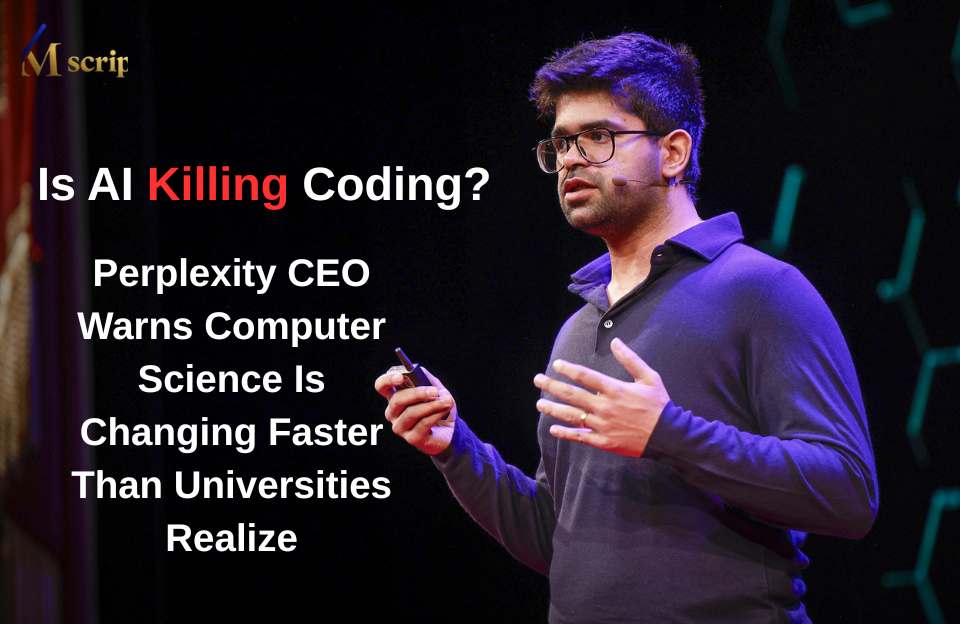
AI Could Replace Traditional Coding, Says Perplexity CEO Aravind Srinivas

100 Best Millionaire & Billionaire Quotes of the Day to Inspire Success and Wealth (2026)

Anna Leigh Waters: The 19-Year-Old Pickleball Star Taking Over the World in 2026

Sendil Palani Net Worth 2026, Biography, Tesla Career & Why Elon Musk Thanked Him After 17 Years

Ankur Jain Net Worth 2026: Biography, Bilt Rewards Founder & Billionaire Story

Meet Anjali Sardana: How the 23-Year-Old Built a $100M Startup After Studying in the US
Why Experienced Engineers Still Matter
Despite AI’s growing capabilities, Srinivas and other industry leaders say human engineers remain essential.
AI still struggles with:
- complex system design
- long-term architecture planning
- large-scale infrastructure
- security and optimization
That means experienced developers who understand deep engineering concepts will still be in high demand.
In fact, some experts say AI will make great engineers even more valuable.
The Bigger Question: Will AI Replace Coding?
The debate sparked by Srinivas highlights a deeper shift happening across the tech industry.
Programming itself may be evolving.
Instead of writing code line by line, future developers may:
- describe software in natural language
- supervise AI-generated code
- focus on design and logic
Some researchers even describe the future of coding as “programming in English.”
In this world, the most valuable skill may not be memorizing programming languages – but knowing how to think computationally.
Why This Story Matters for Students and Future Developers
For students planning careers in technology, Srinivas’ comments carry an important message.
The future of computer science education may include:
- deeper math training
- AI system design
- algorithmic thinking
- data science fundamentals
- prompt engineering and AI interaction
Universities around the world are already beginning to rethink their curricula.
And if AI continues advancing at today’s pace, the way programming is taught could change dramatically within the next decade.
Final Thoughts
The viral debate sparked by Aravind Srinivas isn’t just about coding.
It’s about the future of human intelligence in an AI-driven world.
Artificial intelligence may automate many tasks that programmers used to perform manually.
But the need for deep thinking, creativity, and problem-solving will only grow.
And that may be the biggest lesson of all:
AI might write the code – but humans will still write the future.